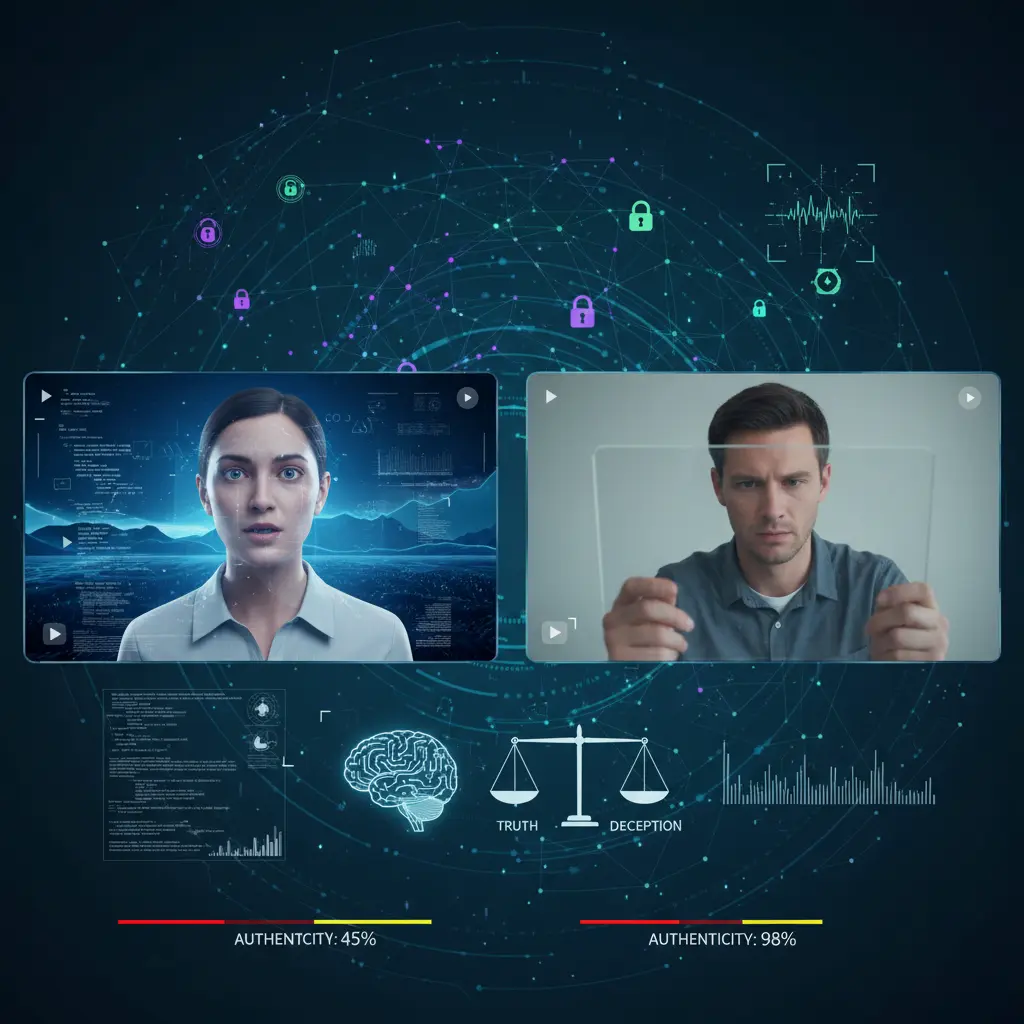
Ultrarealistic AI Video: Can We Still Tell What’s Real?
New generative models have made creating ultrarealistic AI video faster and more accessible than ever. For tech leaders and SME stakeholders this shift raises immediate operational, reputational, and legal questions: how to identify manipulated media, protect customers and employees from deepfakes, and adapt content moderation and communications processes when synthetic media can convincingly mimic real people. This article explains the technology behind modern video generation, surveys real-world misuse, outlines current AI detection limits, and recommends practical defenses organizations can adopt today.
What “ultrarealistic AI video” means and why it matters
Ultrarealistic AI video refers to synthetic video and audio that reproduces human appearance, voice, and motion with high fidelity. Advances in multimodal generative AI — combining text, image, audio, and motion modeling — now enable end-to-end pipelines that turn a script or a short clip into a lifelike scene. That capability amplifies the commercial opportunities for marketing, rapid prototyping, and training, but it also magnifies risks from misinformation, targeted fraud, and privacy violations. Businesses that fail to recognize the speed and quality of these tools risk brand damage, regulatory exposure, and operational disruption.
How the technology works: from training data to final frames
Modern video-generation systems typically combine several components: a generative model for visual frames, an audio or voice synthesis model, and temporal modules that ensure motion coherence. These systems are trained on large multimodal datasets and sometimes fine-tuned on small, subject-specific samples to produce a particular person’s appearance or speaking style. Improvements in model architectures and compute have reduced both cost and latency, allowing near-real-time generation of short clips.
Key technical building blocks
- Frame generators that produce high-fidelity images conditioned on text, poses, or reference footage.
- Temporal models that maintain continuity across frames so facial expressions and gestures remain consistent.
- Neural vocoders and voice cloning that generate believable spoken audio matching lip movements.
- Multimodal alignment to synchronize audio, lip motion, and visual cues for coherence.
Real-world misuse: documented cases and practical threats
Deepfakes and synthetic media have already been used for harassment, political misinformation, and financial fraud. Fraudsters pair ultrarealistic voice clones with video to impersonate executives in phishing-style business email compromise (BEC) schemes or to fabricate public statements from recognizable figures. Misinformation campaigns can amplify false narratives by circulating staged video that appears to show real people endorsing or condemning positions. For SMEs, even a single convincing fake — framed as an executive apology, a false testimonial, or a fabricated news clip — can damage customer trust and trigger costly response efforts.
Detection and mitigation: the current technical landscape
Detecting ultrarealistic AI video remains an active research and engineering problem. Detection approaches include model-based classifiers that learn visual and audio artifacts, signal-level analysis for inconsistencies in lighting or audio phase, and provenance systems that record origin metadata. However, arms-race dynamics make robust detection difficult: as detectors improve, generators adapt to remove identifiable artifacts or intentionally add defenses like invisible watermarks.
Common detection techniques
- Forensic classifiers trained on synthetic vs. real datasets to flag artifacts in pixels or audio spectrograms.
- Provenance and cryptographic signing that attach verifiable origin data at creation time, enabling downstream checks.
- Active watermarking embedded by content-generation platforms to signal synthetic origin.
- Human-in-the-loop review combining automated flags with expert verification for high-risk media.
None of these is a silver bullet: forensic classifiers suffer from distribution shifts when new generators arise; watermarking requires broad platform adoption; and provenance systems depend on supply-chain integrity and user education.
Legal, platform, and policy responses shaping media authenticity
Governments, industry groups, and platforms are developing layered responses. Regulatory proposals often focus on transparency mandates, liability for knowingly deceptive synthetic content, and requirements for platforms to label or remove deepfakes that cause harm. At the same time, major cloud and platform providers are experimenting with watermarking and model-level safeguards that limit easy cloning of public figures. These efforts are part of a broader move to embed governance, auditing, and explainability into generative AI workflows — a trend discussed by industry analysts and researchers as central to 2026 AI strategy for enterprises. For more on strategic AI trends and governance, see the analysis from Microsoft Source on AI trends and perspectives in the MIT Sloan Review.
Practical defenses for SMEs and tech teams
Small and medium-sized enterprises can adopt a pragmatic, layered approach that balances prevention, detection, and response. Below are prioritized actions that offer high return on investment without requiring enterprise-scale budgets.
Prevent: reduce exposure
- Limit public exposure of high-value identity data — executive bios, raw interview footage, and internal recordings—through careful data governance.
- Implement a media minimization policy: treat any public-facing audio or video as potentially reusable for synthetic model training and redact or restrict distribution where feasible.
- Use contractual protections with vendors and partners that restrict re-use of likenesses and require notification of synthesis requests.
Detect: integrate tools and signals
- Deploy automated scanning of inbound media for high-profile channels (press, investor relations, and social feeds) using reputable detection providers and signal aggregation.
- Incorporate provenance checks for media claimed to be official — require signed attestations, metadata verification, or links to authenticated source pages.
- Train communications staff to spot red flags: unnatural eye blinks, mismatched audio-video sync, inconsistent lighting, or unexpected emotional cues.
Respond: workflows and communications
- Create an incident playbook for suspected synthetic media that includes rapid verification, legal escalation, public communications, and takedown requests.
- Establish pre-approved, multi-channel spokesperson protocols so stakeholders can verify real statements quickly (e.g., simultaneous posts on verified corporate channels).
- Engage legal counsel early for cases involving privacy breaches, impersonation, or extortion tied to synthetic video.
Detection limitations and why vigilance matters
Two technical realities make ultrarealistic AI video particularly challenging: first, generator and detector systems co-evolve rapidly; second, synthetic outputs can be post-processed to remove telltale artifacts. That means businesses should assume that automated detection will occasionally fail and prepare for human-driven verification and reputation management. Many organizations and researchers emphasize provenance frameworks and cross-platform watermark standards as the only long-term scalable defense, because they shift the trust decision from artifact detection to verifiable origin metadata. For industry guidance on governance and deployment, resources like Adobe’s digital trends research provide useful context for enterprise strategy.
What to watch next: policy, platform, and research signals
Expect three parallel developments in the near term: stricter transparency and labeling laws in major markets, wider adoption of provenance and watermarking by platform and cloud providers, and continued improvements in both generation and detection capabilities. Organizations should monitor regulatory developments relevant to their jurisdiction and industry, evaluate vendor claims about watermarking and provenance, and maintain flexible governance that can adapt as tools change.
Conclusion: practical realism, not panic
Ultrarealistic AI video presents both opportunity and risk. For SMEs and tech leaders, the right posture is practical realism: acknowledge that convincing synthetic media exists today, invest in governance and basic technical defenses, and implement quick verification and response processes for high-risk incidents. Combining prevention, scalable detection, and clear incident workflows will reduce exposure and protect trust while enabling companies to responsibly experiment with generative AI for legitimate use cases.
Recommended next steps: inventory public-facing media assets, adopt a verifiable provenance requirement for official releases, run tabletop exercises simulating a deepfake incident, and evaluate a detection vendor or managed service that fits your team’s capacity.